PON Technology Explained: OLTs, EPON, GPON and XPON Routers
Fiber internet has become the standard for anyone who wants fast, stable connectivity, whether that's a home in Nairobi or a business estate served by a local ISP. Behind almost every fiber connection sits a technology most people never hear about, PON, short for Passive Optical Network. This guide breaks down what PON actually is, the role OLTs play, and how EPON, GPON and XPON differ, so the next time someone mentions these terms you'll know exactly what they mean.
What Is a PON, in Plain Terms?
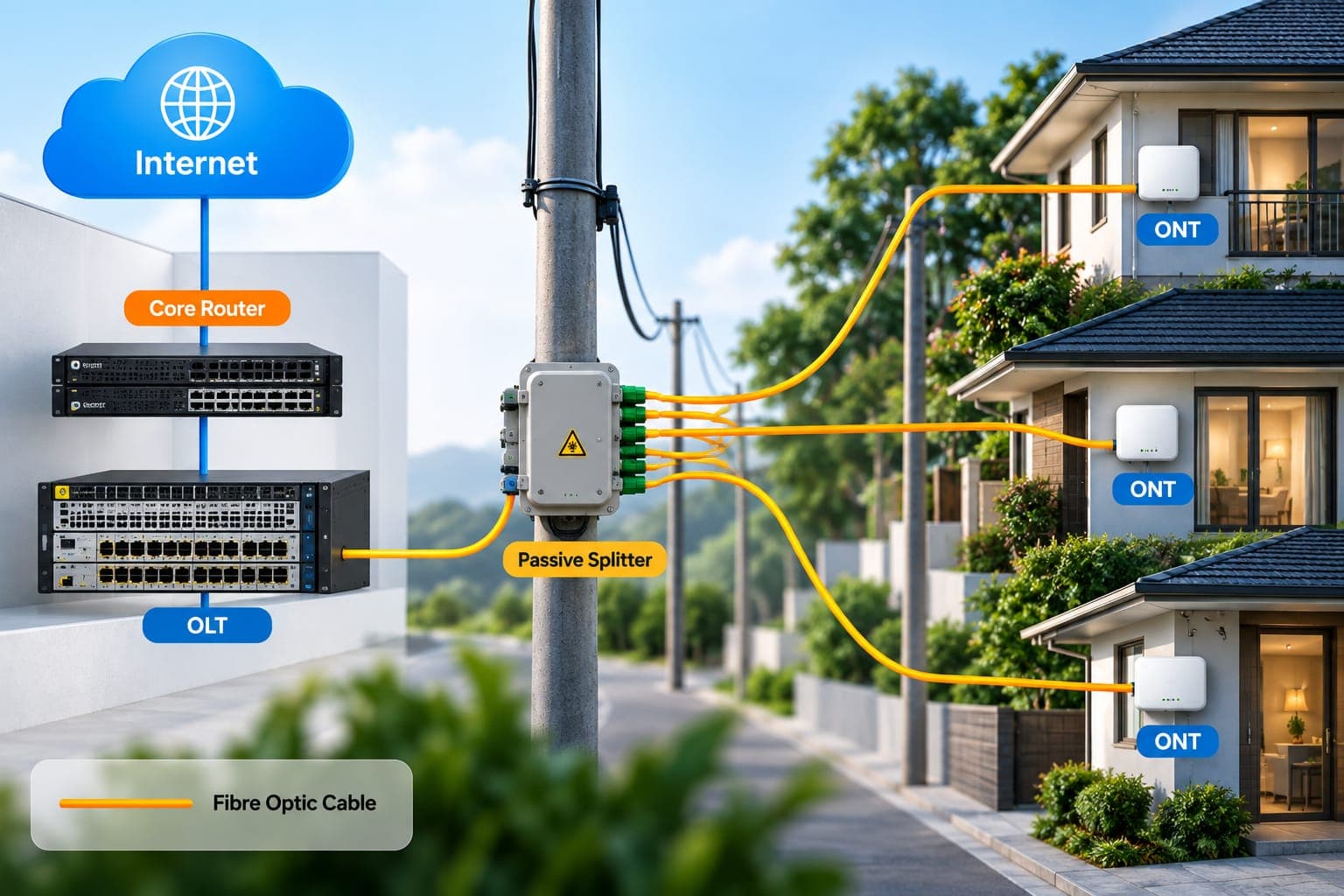
A Passive Optical Network is a way of delivering fiber internet from an ISP's equipment room all the way to a home or office, using a single fiber strand that's split to serve many customers at once instead of running a dedicated fiber line to every single building. The word "passive" is the key part, the splitters used along the way don't need electricity, they simply divide the optical signal using nothing but the physical structure of the fiber itself. That makes PON networks cheaper to build and maintain than a fully active fiber network where every splitting point needs powered equipment.
This is why PON has become the backbone of FTTH, Fiber to the Home, deployments across Kenya and much of the world. A single fiber line from the ISP can be split to serve dozens of homes on the same street, which keeps costs down for both the provider and the customer.
The Role of the OLT
The OLT, or Optical Line Terminal, is the equipment that sits at the ISP's end of the network, usually in a data center or a local point of presence(POP). Think of it as the traffic controller for the entire PON. It converts the ISP's internet traffic into optical signals, sends them down the fiber, and manages how bandwidth is shared and prioritized across every customer connected to that line.
On the customer's end sits the ONU or ONT, Optical Network Unit or Terminal, which converts the optical signal back into something a router or device can actually use. Some ONTs are simple modems, while others, like combined GPON or XPON routers, handle both the fiber conversion and WiFi routing in a single box.
The OLT and ONU communicate constantly to allocate bandwidth fairly using a scheduling process, so even though dozens of homes share the same fiber strand, each one gets a consistent connection rather than fighting for bandwidth like an old shared cable network might.
EPON vs GPON, What's the Difference?
This is where a lot of confusion comes in, since both are widely used PON standards but they come from different technical backgrounds.
EPON, Ethernet Passive Optical Network, was developed with Ethernet framing at its core, which made it a natural choice for networks that were already built around Ethernet standards. It's simpler in some respects and has historically been cheaper to deploy, which is part of why it's popular among smaller ISPs and in regions where cost is a bigger factor than raw specification numbers.
GPON, Gigabit Passive Optical Network, uses a different encapsulation method called GEM, Generic Encapsulation Method, which allows it to carry a wider mix of traffic types more efficiently, including voice, video and data together. GPON also generally supports higher split ratios and longer distances than EPON, which is one reason it has become the more common standard among larger telecom operators and fiber providers.
In practical terms for an installer or technician, the biggest thing to get right is compatibility, an EPON ONU will not work on a GPON OLT and vice versa, so knowing which standard your ISP runs is essential before ordering equipment for a job.
What Does XPON Mean?
XPON isn't a separate standard on its own, it's a general term used to describe equipment that supports multiple PON standards, most commonly both EPON and GPON, sometimes alongside older or newer variants too. An XPON router or ONU can auto-detect or be configured to work with whichever standard the ISP's OLT is running, which makes it a flexible option for technicians who install and support equipment across different networks rather than committing to a single standard.
This flexibility is a big reason XPON devices have become popular with installers in Kenya, since you can stock a single model of router rather than separate EPON-only and GPON-only units, and simply configure it to match whichever network you're connecting it to on any given job.
Why This Matters for Installers and ISPs
Understanding these distinctions isn't just theory, it affects real purchasing and installation decisions:
Ordering the wrong ONU type for an OLT means a device that simply won't register on the network, wasting a site visit.
GPON's higher split ratios mean fewer OLT ports are needed to serve the same number of customers, which affects how an ISP plans its infrastructure costs.
XPON equipment gives technicians flexibility when working across multiple ISPs or when a network is transitioning between standards.
Passive splitters, patch panels and fiber termination boxes all need to match the fiber type and connector standard being used across the network, getting this wrong at the physical layer causes signal loss regardless of which PON standard is running.
The Physical Layer, What a PON Installation Actually Needs
Beyond the OLT and ONU, a working PON installation depends on the physical fiber infrastructure connecting them. This typically includes an ODF, Optical Distribution Frame, where incoming fiber lines are organized and terminated, PLC splitters that divide the signal to multiple customer lines, and various termination boxes and enclosures that protect the fiber connections at each point along the route.
If you're setting up or expanding a PON installation, Talisa Technologies stocks the fiber infrastructure that goes into these builds:
XPON SDBI Router (EPON & GPON Support), a flexible ONU-router combo that works across both major PON standards
ODF 24C SC/UPC Simplex for organizing and terminating fiber lines
FAT Box SC/UPC 1x8 Outdoor Loaded PLC Splitter and 1x16 and 1x32 variants for splitting signal to multiple customer lines
GLK Automatic Fiber Cleaver for clean, precise fiber termination
Netlink Single-Mode Media Converter 1000Base-FX for converting between fiber and Ethernet where a full PON setup isn't needed
Final Thoughts
PON technology is what makes affordable, scalable fiber internet possible, and understanding how the OLT, ONU, and splitters work together, along with the practical differences between EPON, GPON and XPON, makes a real difference whether you're planning a network rollout or troubleshooting a single customer connection. Getting the standard right at the start saves wasted trips and mismatched equipment down the line.
Browse the full range of fiber and networking equipment at Talisa Technologies, or call +254724368347 and the team can help you source the right gear for your installation.