PTP vs PTMP: What's the Difference, and Which One Do You Actually Need?
If you've been shopping for a wireless bridge or an outdoor access point, you've probably run into these two terms sitting right next to each other on a spec sheet: PTP and PTMP. They sound like they belong to the same family, and in a way they do, but they solve completely different problems. Buy the wrong one and you'll either be paying for range you don't need or missing the coverage you actually wanted.
Here's what each one really means, how they behave differently in the field, and which real hardware fits each job.
What Is PTP (Point-to-Point)?
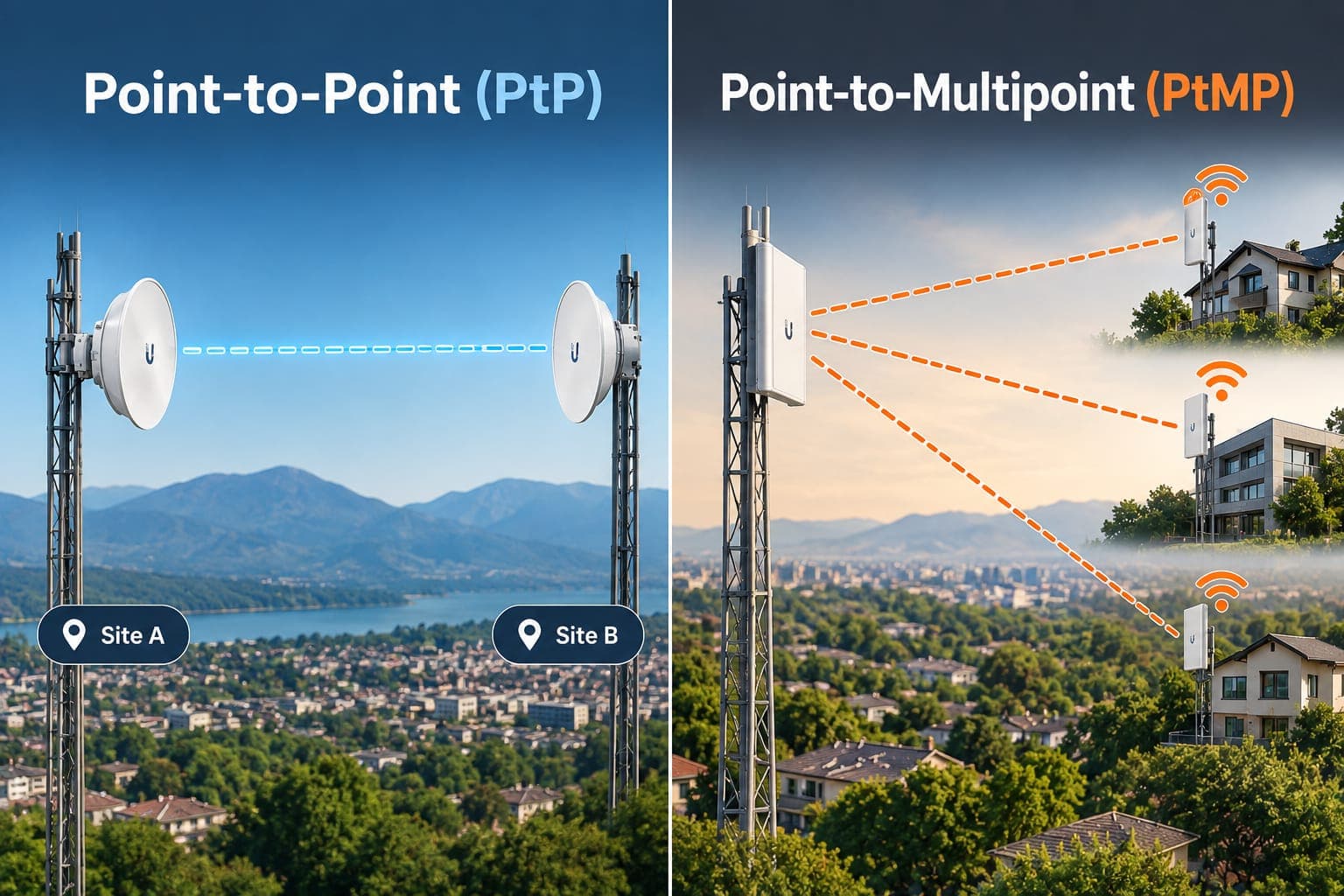
PTP stands for point-to-point. It's a dedicated wireless link between exactly two locations, one device on each end, aimed directly at each other. Think of it as a wireless cable. It doesn't broadcast in every direction, it focuses almost all of its signal energy in one tight beam toward a single receiver on the other side.
Because all the power goes into one direction instead of spreading out, PTP links can cover serious distances while staying fast and stable. This is the setup you reach for when you need to connect two fixed points that can't be joined by a physical cable, say, two office buildings across a road, a warehouse and a main office a few kilometers apart, or a rural site where laying fiber isn't practical.
A dish antenna or a directional bridge unit is the typical hardware here. The Ruijie RG-EST330F-P, a 3km, 13dBi wireless bridge, is a good example of purpose-built PTP hardware. It's designed to aim at one specific partner device and hold a stable link across distance, not to serve a crowd of random client devices nearby.
What Is PTMP (Point-to-Multipoint)?
PTMP stands for point-to-multipoint. Instead of one device talking to exactly one other device, a PTMP setup has one central access point serving multiple client locations or devices at once, all connecting back to that single hub.
This is the model behind most WISP setups and estate WiFi deployments. One sector antenna sits on a tower or a rooftop and covers a wedge-shaped area, sometimes 90 or 120 degrees wide, serving dozens of client radios scattered across that coverage zone at the same time. Unlike PTP, the signal isn't aimed at one target, it's spread across an angle wide enough to reach many subscribers.
The tradeoff is straightforward: spreading signal across more directions means less power reaching any single client compared to a tightly focused PTP beam, and it means all connected clients are sharing the same available bandwidth from that access point. This is exactly why sector antennas and PTMP-focused hardware are built differently from PTP bridges, they trade raw distance and per-link speed for the ability to serve many people from one location.
The Ruijie RG-EST450G, a 15dBi unit with a 120° built-in antenna, is built exactly for this. That 120-degree spread is the giveaway, it's meant to cover a wide arc of subscribers rather than lock onto a single partner device the way a PTP bridge does.
PTP vs PTMP: The Practical Differences
PTP | PTMP | |
|---|---|---|
Connects | Two fixed points | One hub to many clients |
Signal shape | Narrow, focused beam | Wide sector coverage |
Typical range | Longer, since all power goes one direction | Shorter per client, power is spread out |
Bandwidth | Dedicated to the one link | Shared across all connected clients |
Common use | Building-to-building backhaul, remote site links | WISP subscriber coverage, estate or campus WiFi |
Example hardware | Directional bridge (e.g. RG-EST330F-P) | Sector antenna AP (e.g. RG-EST450G) |
When You Actually Need PTP
Reach for a PTP setup when you're solving a "these two specific places need to talk to each other" problem:
Connecting a branch office to a main office where running fiber isn't an option
Linking a tower or rooftop site back to your core network as a wireless backhaul
Bridging two buildings on the same property that aren't cabled together
Any situation where you need the most reliable, fastest possible link between exactly two fixed points
If you only have one client to serve and distance or line-of-sight is the challenge, PTP is almost always the right call. Don't use a wide-coverage sector antenna for this job, you'll be wasting signal strength on empty air instead of concentrating it on your one target.
When You Actually Need PTMP
Reach for a PTMP setup when you're solving a "many people need to connect to one access point" problem:
A WISP serving multiple households or businesses from a single tower or rooftop location
Estate or apartment complex WiFi where several buildings need coverage from a central point
A campus or compound where devices move around and need coverage across an area, not a single fixed link
Any deployment where the number of connected clients is expected to grow over time
For indoor or general-purpose outdoor coverage where you're not specifically running a sectorized subscriber network, an omnidirectional access point is often the simpler, more flexible choice. The Ruijie RG-RAP6202(G), a Wi-Fi 5 AC1300 outdoor omni-directional access point, spreads coverage in all directions rather than a single sector, which makes it a good fit for compound-wide coverage rather than a directional WISP deployment.
A Common Mistake Worth Avoiding
Technicians new to outdoor wireless sometimes try to stretch a PTMP sector antenna to do a PTP job, or the reverse, aim a tightly focused PTP bridge at a wide area expecting it to serve multiple scattered clients. Both usually end in disappointment. A PTP bridge pointed at open air past its intended single target won't magically pick up other devices, and a PTMP sector antenna asked to reach PTP-level distance to one far client will fall short of what a proper directional bridge could deliver over that same distance.
Match the hardware to the actual topology of the problem: one-to-one gets a directional bridge, one-to-many gets a sector or omni access point.
FAQ: PTP and PTMP Wireless
Can I use a PTP bridge to serve multiple clients? Not effectively. PTP hardware is built to focus signal into a narrow beam aimed at one partner device, so pointing it at a wider area to catch multiple clients sacrifices the range and stability that make PTP useful in the first place.
Which one is faster, PTP or PTMP? PTP is generally faster and more stable per link, since all available bandwidth and signal power go to a single connection instead of being shared across multiple clients.
Do I need a license to run PTP or PTMP wireless links in Kenya? Most standard 2.4GHz and 5GHz unlicensed-band equipment, like the hardware covered here, doesn't require a spectrum license for typical deployments, though larger commercial WISP operations should confirm current requirements with the Communications Authority of Kenya.
Can a PTMP network include a PTP link as part of it? Yes, and this is common. A WISP might use a PTP bridge to backhaul a remote tower site back to its core network, then run a PTMP sector antenna from that same tower to serve local subscribers. The two aren't mutually exclusive, they're often used together in the same overall network.
Final Thoughts
PTP and PTMP aren't competing technologies, they're two different tools for two different jobs. PTP gives you the strongest possible link between two fixed points. PTMP gives you the ability to serve many clients from one location, at the cost of shared bandwidth and shorter effective range per client. Once you know which problem you're actually solving, picking the right hardware stops being a guessing game.
Not sure which setup fits your site? Call +254724368347 and the team at Talisa Technologies can help you match the right PTP or PTMP hardware to your actual deployment.